
Match market research tools to the decision in front of you
Three jobs hide inside every top market research tools list: paid respondents, public landscape sources, and competitor monitoring. Pick one per decision.

In this article
Every "best market research tools" list you'll find is written by a vendor and sorts three different jobs into one ranking. A survey panel, an analyst subscription, and a competitor tracker sit side by side, scored on the same stars, as if a product team ever needed all three for the same question.
You don't. A product decision needs one of three things: an answer from people who fit your buyer, a read on how the category is moving, or a warning that a competitor did something. Each is a separate job with a separate tool and a separate price, and most weekly decisions need one at most.
This guide splits the category by job, says when each one earns its cost, and ends with a stack small enough for a product team that has no insights department.
Three jobs hiding inside "market research tools"
Ask a product manager where their market research comes from and the answer is a mix. Product analytics for behavior. A bought report from an analyst firm. A monthly competitive pass from product marketing. A survey when someone senior wants a number.
Sort those sources by what they answer:
- Ask respondents: you pay people who match your buyer to react to a concept, a price, a message, or a list of features. Survey panels, interview recruiting, and message testing tools live here.
- Read the landscape: you read what's already public about the category. Analyst reports, statistics databases, funding databases, review sites, and public filings live here.
- Monitor competitors: you watch a short list of named companies for changes. Pricing trackers, changelog feeds, job post alerts, and competitor intelligence agents live here.
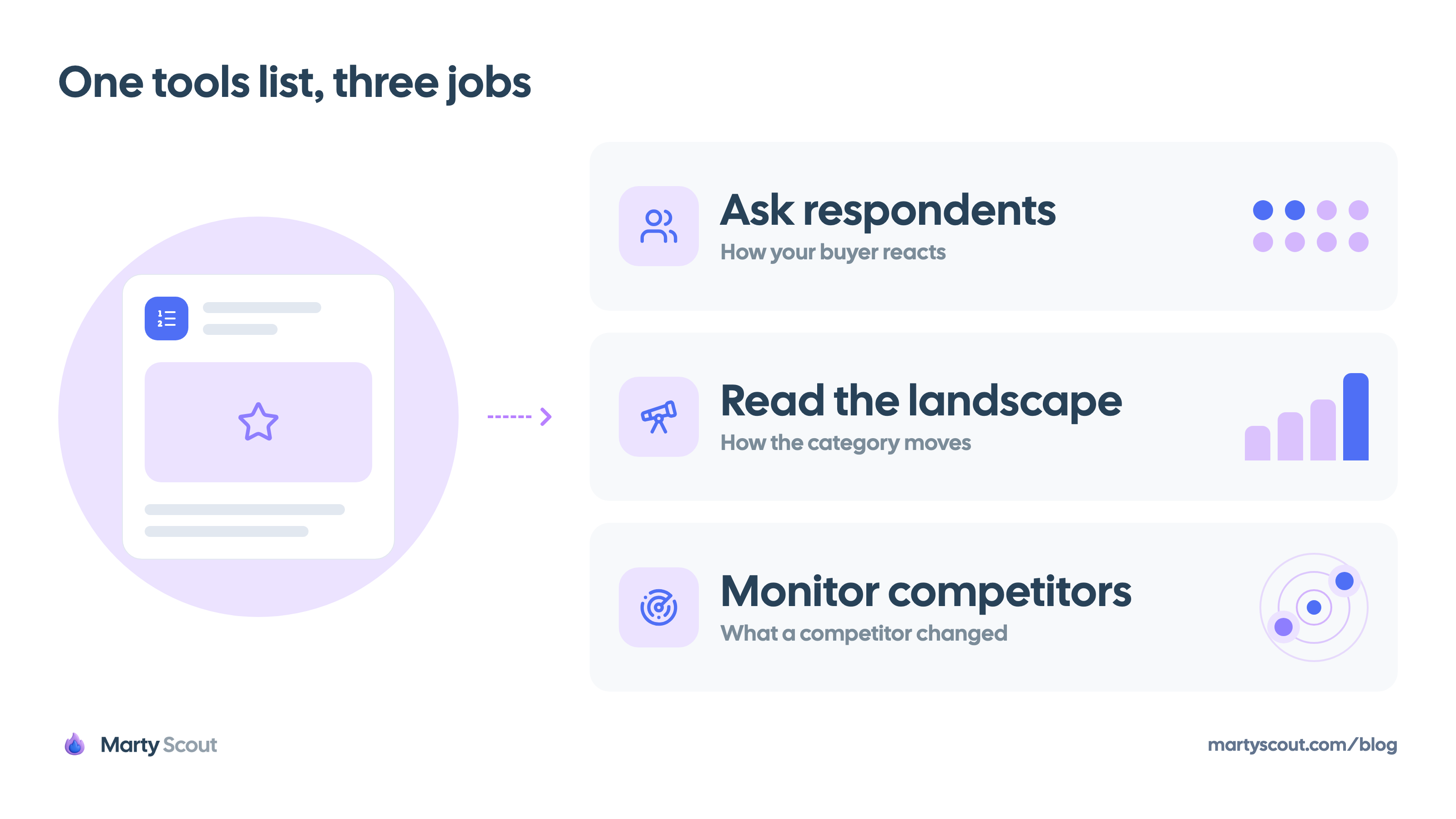
The first job costs money per answer. The second costs a subscription or nothing. The third costs attention, every week, forever. Vendor lists blur them because a suite like Qualtrics sells all three under one login, and because Emporia bundles "market intelligence" next to concept testing. The bundle is a sales motion. It isn't a description of your decision.
Before you open a tool, write the decision down in one sentence. "Should the new plan be priced per seat or per workspace?" is an ask-respondents question. "Is usage-based pricing winning in our category?" is a landscape question. "Did our main competitor change its value metric?" is a monitoring question.
When you still pay for a verified panel
Some questions can't be answered by reading. Whether your buyer understands a new message, which five features they'd trade for a sixth, or what price feels expensive: these need people, and the wrong people give confident wrong answers.
The difference that matters in B2B is verification, not size. SurveyMonkey LaunchPad packages monadic tests, MaxDiff, and Van Westendorp pricing on top of a panel it describes as 335 million people across 130 countries, with studies from $1,000 and results in hours. That's the right tool for a consumer packaging test. It's the wrong tool when the respondent has to be a head of security at a company with more than 500 seats, because a panel that large is filled by screener self-report.
B2B panels sell the opposite tradeoff. Wynter recruits from a network it describes as 86,000 verified B2B professionals, checks each one against a corporate email and LinkedIn, and promises answers in 12 to 48 hours for message tests and ICP surveys. Respondent claims 3.1 million verified professionals plus work-email verification and video screening, with a typical study filled in about a day and a half. CleverX, which ranks itself first in its own comparison, still gets the principle right: pick on panel verification and depth, not volume.
Pay for a panel when all three are true:
- The question is about your buyer's reaction, not about the market. A price sensitivity curve, a message test, a feature tradeoff.
- The decision is expensive to reverse. A pricing change, a positioning change, a quarter of roadmap.
- You can name the respondent by role, company size, and a behavior that proves they're the buyer, such as "has renewed a contract for a tool in this category in the last year."
If any of the three is false, you're paying respondents to tell you something a public source already says, or asking people who'll never buy from you.
When a public landscape source is enough
Most category questions have a public answer. Where funding is going, which segments are growing, and which pricing models new entrants chose are all readable without recruiting a respondent.
The tools here are cheap and boring:
- Funding and company data: Crunchbase for rounds, headcount signals, and who backed whom. A round in your category is a landscape event before it's a competitor event.
- Statistics and reports: Statista for market size claims you can cite, with the caveat that a market size number is only as good as the definition under it. Analyst firms cover the same ground at a price that makes sense for an insights department and rarely for a product team.
- Reviews: G2 and Capterra for what buyers say about the category, read as themes across ten products, not as a score for one.
- Your own funnel: the answer to "what do people compare us with" usually sits in your sales calls and closed-lost notes, and it's free.
A landscape pass answers "how is the category moving" well enough for a roadmap conversation. It answers "what will our buyer pay" badly, because public data tells you what vendors charge, not what buyers accept. That's the seam where teams misuse this job: they read three pricing pages, average them, and call it pricing research.
When a landscape finding changes a decision, it belongs in the same place competitor news goes. The competitive intelligence brief has a section for it, and one line there beats a forty-slide deck nobody opens.
When an AI research pass is the wrong spend
The newest column in every 2026 tools list is AI research: agents that read the web and write a report, or synthetic respondents that answer a survey with no person behind them.
Use the split above to judge them. For the landscape job, an AI pass is a strong first draft. It reads more pricing pages, filings, and reviews in an hour than you'd read in a week, and the output is a set of claims with sources you can check. Check them. The failure mode isn't hallucination so much as staleness: an agent summarizing a pricing model that changed last quarter sounds exactly as confident as one that's current.
For the ask-respondents job, an AI pass replaces the wrong input. A synthetic panel reproduces what's already written about buyers like yours. It can't tell you that your new message confused a security lead, because no security lead read it. If the decision is expensive to reverse and the question is about reaction, you still pay a person.
For the monitoring job, an agent is the right shape, because monitoring is reading the same sources on a schedule and reporting only the changes that matter to your product. That's work a person does badly after week three. Marty Scout does that job: it watches competitor launches, pricing, hiring, funding, and product updates, filters them by your product context, and sends a short briefing to Slack, Telegram, or iMessage. It doesn't run a Van Westendorp study or size a market, and it shouldn't.
The decision that looks obvious and fails
Here's the mistake no tools roundup covers. A team buys a panel subscription to "get closer to the market," runs two studies in the first month, and then the subscription sits. By month four the team is reading competitor pricing pages by hand again, and the panel renews anyway.
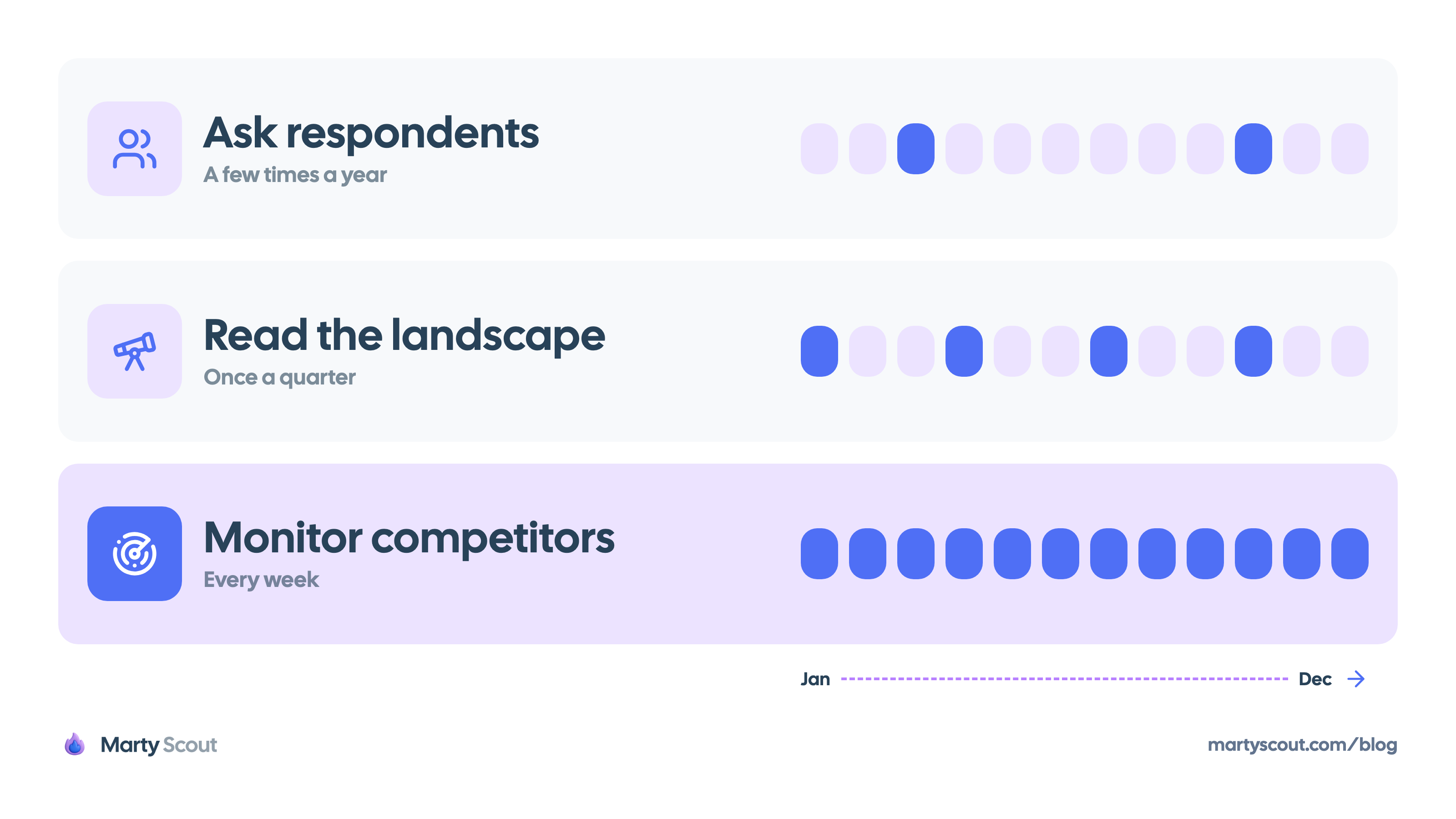
The three jobs run on different clocks:
| Job | Cadence | Trigger |
|---|---|---|
| Ask respondents | A few times a year | A decision that's expensive to reverse |
| Read the landscape | Quarterly | Planning, a board update, a new segment |
| Monitor competitors | Weekly or daily | Never; it runs on a schedule |
A subscription makes sense only for the job that runs on a schedule. The other two are bought per decision. Structure the budget that way and the panel money stays unspent until a pricing question earns it, which is the point.
The second failure is the opposite: treating monitoring as research. A competitor's price change is a fact about them, not about your buyer. If the team reads "they moved SSO down a tier" and changes its own packaging the same week, it has answered an ask-respondents question with a monitoring signal. The pricing change routine covers how to catch the move. Whether to follow it is a separate question, and often one worth a real study.
A small stack for a product team
An insights department runs all three jobs with dedicated people. A product team of one to five runs them with a budget line, a subscription or two, and an hour a week. This is what that looks like:
- Ask respondents: no subscription. One verified B2B panel on file, with a screener template ready, used two or three times a year for pricing, packaging, and message decisions. Budget per study, not per month.
- Read the landscape: one funding database, one review site, and your own closed-lost notes. Pull them together once a quarter before planning. Add a statistics database only when someone has to cite a market size to a board.
- Monitor competitors: the one place automation earns a subscription. Three to five named competitors, a fixed list of sources, and a briefing that arrives without anyone opening a dashboard. If you run it by hand, cap it at an hour a week and rotate the owner.
Every line maps to a decision the team already makes.
Your first move
Take the next three decisions on your roadmap and write each as one sentence. Next to each, mark which job it needs: respondents, landscape, or monitoring. If two of the three say "landscape" and none says "respondents," you don't need the panel subscription someone proposed. If one says "monitoring," that's the job to automate this week.
FAQ
Where do product teams get market research reports?
Most of what an analyst report says about a category is readable from public sources: funding databases for who's raising, review sites for what buyers complain about, and vendor pricing pages for how the category charges. A statistics database such as Statista fills in cited market sizes when a board deck needs one. Buy an analyst report only when a specific decision depends on a claim you can't reconstruct yourself.
How does a survey panel differ from competitor monitoring?
A survey panel pays people who match your buyer to answer a question you wrote, so it tells you about your buyers. A competitor monitoring tool reads public sources on a schedule and reports what named competitors changed, so it tells you about them. They answer different questions and run on different clocks: a panel a few times a year, monitoring every week.
Do you need a research background to run a pricing study?
Not to run one. Tools such as SurveyMonkey LaunchPad package methods like MaxDiff and Van Westendorp so the survey design is done for you. You still need to write a screener that separates your buyer from a look-alike and to read the result with some skepticism about who answered. An hour with a researcher before launch is cheaper than a study that sampled the wrong people.
How do you tell a verified B2B panel from a consumer panel?
Ask how each respondent's job title is confirmed. A verified B2B panel checks against a corporate email address, a LinkedIn profile, or both, and often reviews audiences by hand. A large consumer panel relies on screener self-report, which is fine for a packaging test and useless for a "heads of security only" study. Panel size is not the signal. Verification method is.
When is an AI research pass enough?
An AI research pass is enough for the landscape job: it reads public sources fast and gives you claims with links to check. It's the wrong spend for a reaction question, because a synthetic respondent repeats what's already been written about buyers like yours instead of reacting to your message or price. If the decision is expensive to reverse and the question is about how a buyer responds, pay for people.
Related articles
Compare competitor prices when every plan meters differently
Seats, credit pools, and per-outcome fees can't share one price column. Price three buyer profiles on every competitor instead, with a worked example.
Competitor analysis and benchmark templates that decide
Two copy-ready worksheets: one competitor and one question, or one metric across several. Every cell carries a source, a date, or an honest blank.
Competitor launched a feature? Use this response framework
Two questions sort any competitor launch into one of four responses: log, watch, reposition, or respond. Includes the scoring rules and a 48-hour timeline.